
Locking Horns, Bloody Coronations: The Enigmatic Talent of Justin Gaethje & How He Beat Ilia Topuria
An explanatory study on Justin Gaethje's always-existent potential and how he defied all odds by living up to that in his Fight of the Year upset over Ilia Topuria.

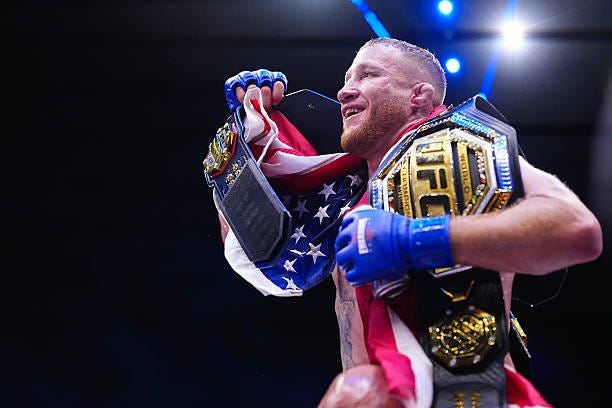
Introduction: Inevitable, But Never Invincible
There’s a notion of absolutism when it comes to discussing combat sports, mainly built around a fixation on hierarchy; everyone wants to see a set, rational order to their circumstances. This isn’t entirely a negative, but, especially when it comes to predictions of possible outcomes, I often have asked myself with a level of unease about accepting that any kind of hierarchy is impossible to disrupt without some transition onto the next generation. What I’m getting at here is that, if you have taken any sort of endeavoring into the historical or technical sides of combat sport appreciation, you eventually realize that seeming inevitability isn’t actually a guarantee - that everyone can lose and they may well will in a game designed to wear at their seams until patches come undone or there’s a small part not wound securely enough to avoid a tear.
Ilia Topuria is undeniably one of the most absurd talents Mixed Martial Arts has ever seen, specializing in his masterful command of feints, strike selection, and insistent decision-making to control where exchanges occured. He then left every single man he fought as decoration on his wall of the conquered. Topuria was not just purposeful, he maintained a concentrated, stubborn pursuit of his commanding presence, navigating and then executing three of the finest champions the sport has ever seen back-to-back-to-back. Alexander Volkanovski demanded the most refined pressure of the Spaniard’s career, managing to be difficult to limit even under pursuit, but Topuria slowly closed in one of those escape routes until he pinned him completely. Max Holloway asked how composed Topuria could be under excessive mental pressure of volume, pace, and a fellow uncompromising thinker. Topuria didn’t and couldn’t match Holloway in output, but he stayed in that fire with Holloway and picked his moments to pounce, never wavering from the goal until he got there. Charles Oliveira, the greatest bull of them all, went for Topuria’s neck immediately, asking if he could play to his namesake or get run over. Topuria proved he could do that, never wavering from the most dangerous opponent yet, picked off Oliveira’s offense, and then drew him in for a decisive finish.
I’ve been extensive in my appraisal of Topuria’s abilities, though I think it’s worth pointing to the fact that I’ve long-learned that no one in Mixed Martial Arts is invincible - and I’ve never once believed he was either as that same piece articulates. In a sport built around so much variety and outcomes, its inherent draw for us is that it can always surprise you. Topuria had been made mortal before, but the outcomes remained the same. But every great, less they leave the sport before it happens, eventually runs into a wall that they simply couldn’t overcome. I think the surprise lies in that, under the current contexts of their careers and who they were, Justin Gaethje being the one to do so astonishes me as much as it goes to show - it really can just be the right person with the right combinations of tools, gameplanning, and resiliency. That sometimes, they just happen to be the right one at the exact right time where the pieces fall into place.
But before we talk about how the best fight of the year so far went down, I want to discuss the history of the person who beat the man many pinged as arguably the best in the world.
The King of Violence
Justin Gaethje stormed his way into the UFC unbeaten, but already very much a road warrior, covered in bruises. Gaethje had melded himself into a committed, all-offensive attritional warmonger, blistering his foes with forward motion, punishing their movement with one of MMA’s most terrifying leg kick offenses, and mauling them in the clinch.
He punched and clubbed his way to the top of the World Series of Fighting’s lightweight throne with commitment to the war itself, showcasing a gift for ruthless creativity and otherworldly highlights even if it came at some cost. Entering the UFC was an obvious step, but how far was this warpath to take him?
Michael Johnson was a fighter who could be hot-cold on his days, but he was an elite lightweight in his best form when Gaethje was paired with him - with the handspeed and shocking pop to make others worry, Johnson sent Gaethje back immediately, only for the psychotic grin to be right back in his face. And even worse, Gaethje threw with combination handspeed he had never had before, his pressure now at its most refined, now set upon the elite competition that he proved to be every bit a match to.
With the constant threat of counters of his high guard, Gaethje avoided the guard’s ranged limitations by staying close, forcing his opponents to constantly backstep, then ruthlessly cut them off. The choice became to either throw back at the risk of taking another counter, or get your mobility compromised every time you move. To fight Gaethje meant you were never going to be safe - you either took him out or you had to outdamage him.
And these sorts of things proved easier said than done due to Gaethje’s defenses and timing being far better than the violence of his fights would suggest. Gaethje was likely to end his contests bruised up this way, but his use of the fence, deceptively solid defensive weaving, and constant opportunism made him spiritually and physically demoralizing to fight.
That said, Gaethje’s offense held a key flaw, namely that he was reliant upon his skillset and toughness being greater than his opponents. What happened when Gaethje faced those who couldn’t just fight back, but could stay composed in a battle of wills to make his side of the culminating-damage race not a guaranteed winner?
Even then, it was never impossible to hurt Gaethje, his own commitment to the fire itself meant he was going to be susceptible to damage no matter how well he handled it. Simply put, while he could fight tired, Gaethje was fighting at a pace that he simply could not sustain unless his efforts paid off. Gaethje always knew he was mortal, but he kept fighting like he was invincible - and his demand for an equal was going to be met like all the rest.
Eddie Alvarez and Dustin Poirier proved to be those foils, taking everything Gaethje could dish out and giving it back. Unlike Johnson, who found himself never able to escape the arms race, they committed themselves to the understanding that they couldn’t - steeling themselves to outfighting Gaethje with tactics as much as their ironclad determination.
Both Alvarez and Poirier recognized that Gaethje was willing to throw back, but his defenses were on a hair-trigger to try to keep himself close, leading them to overwhelm his responses or draw him into their own counters. Their jabs proved essential here, managing to get pivotal breathing room in the midst of nonstop action.
Poirier’s jab in particular ended up being his difference-maker, especially as a desperate struggle between his rear hand counter vs Gaethje’s leg attack became a focal point of their engagements, allowing him to set up a finishing sequence for the ages.
Alvarez’s jab let him reverse the tide in a different way, eventually leading both to the realization that the veteran lightweight legend’s simple efforts in attacking in the clinch were more potent attritionally than anything else. Gaethje systemically lost control of the fight by virtue of experience in what was Alvarez’s last great victory.
It bears pointing out that it took every ounce of themselves for Alvarez and Poirier to win two of the finest battles the sport has ever seen - and they were close until they very end to a loss themselves. Nonetheless, Gaethje’s entry into elite contendership proved he belonged and that he was a massive threat for any and all lightweights. And yet, his first three bouts reflected his ability as much as it indicated his flaws. Gaethje gave every ounce of himself, but, at best, he was still tanking enormous damage and, at worst, finished by those capable of handling him. Gaethje could have committed to staying the most violent man on the roster - yet the duology of losses led to a change.
Perspectivist Potentials and Pitfalls
It was gradual, but, by the time Gaethje faced the perennial divisional boogeyman, Tony Ferguson, there was a difference. No longer was he pressing at an exhaustive rate, but instead engaging at more of a distance in neutral space. He was more willing to back up, yet he’d still press if given the opportunity.
If Gaethje’s previous style could be undone by game opponents, then the answer was to reallocate his game around diffusing them without compromising some of his strengths. Gaethje was always an excellent counterpuncher with a solid grasp of how to pick off his opponent’s shots; if opponents were already paying for throwing back, why not draw them into the counters?
He was good at controlling fights with his counterpunching - why not make ‘control’ the foundational feature? Why work so much at a potential cost if there were ways to mitigate them?
This meant the development of better boxing fundamentals from Gaethje. More active upper body fakes and feints were used to threaten opponents than all-out power; he would use his lead hand to parry and draw opponents in. Weaves and dips let him step in and across on them to set up power shots at deceptive angles.
I won’t mince words here: there are such things as fighters being able to operate at different gears or are well-rounded enough to know when to play with passivity versus aggression, but it is an inherent rarity to see a reinvention of this sort. Gaethje had the attributive physicality to handle dangers, he was dangerous and punishing in transitions, and still retained a fearlessness to engage if he had to, but now he had a few tricks that made him more unpredictable and versatile. The Gaethje who found himself backstepping from someone willing to work his midsection could try and outposition them for a counter. He might surprise into a shift into a transitional attack. Gaethje’s relentless, psychiatric desire for complete termination had been re-tempered into someone who could still do that, but could maintain composure at a measured rate tactically. Again, this isn’t really something just about every fighter does or can do based upon their comforts; Gaethje’s style changed the dial on what he did without sacrificing some of the core components of what made him an elite lightweight still. In the process, he greatly increased the chances of his longevity - and most importantly, indicated that he was one of the most talented lightweights the sport had ever seen.
And yet, this seemingly new, ‘improved’ Gaethje still ran into walls; he ran into fighters that were better than him. The question becomes, ‘Why?’ If he’s mitigating risks whilst still catering towards effective strengths, then what were the problems?
One important feature of combat sports technique that is constantly discussed is ‘initiative’. But what exactly does that mean? I view ‘initiative’ as the defining way a fighter manages to dictate a fight. There are many ways to establish it, though Mixed Martial Arts does tend to put a premium on aggressiveness as the main way of doing so. But that’s not necessarily the case: sometimes, it involves having superior positioning, being able to land at a higher tempo, or constantly even making the other person think. Someone who controls the ‘initiative’ is ‘first’ and can still afford to not be in danger if they’re not. The easiest way to identify who has the initiative is often who is winning or in control.
Why this matters in context of Gaethje himself is that we have to think about how he attempts to establish his own ‘initiative’ - and why neither version of him did so as effectively as he could have. The pressure iteration of Gaethje forced opponents into a firefight where they had to keep up or they would fall apart, but, again, Gaethje’s ‘initiative’ relied upon him being better and tougher and able to outlast them; resilient foes could constantly swing the pendulum their way just by being willing to fire back.
The fatal flaw of Gaethje’s neutral space style was the complete opposite problem: he is too based around being reactive. Gaethje’s distance management is preserved mainly through feints and the commitment to needing to counter; his footwork isn’t necessarily great on the backfoot enough to keep opponents who are willing to apply mixups off of him. To rephrase a point I made a few years ago, Gaethje’s counters will punish predictability, but variety from anyone and everyone punishes him everywhere else. In other words, Gaethje’s initiative here isn’t really enforced at all unless the opponent is threatened enough. In exchange for risk management and energy conservation, he doesn’t employ other ancillary techniques and strategy to overcome his opponents; instead, he relies upon his natural comfort in finding the right shots alone. This has led to active regressions in some of his previous greatest strengths, such as his ability to keep opponents pinned or being able to force the conditions best suited for his leg kicks - resets. And, lastly, in a state of constant reactivity, he actually failed to address his hair-trigger defensive reactions that often let opponents build momentum on him.
To take a direct quote I made after Gaethje’s second title attempt: “What separates the skilled fighters from the special fighters of a division is how they recognize the margins of importance with minutes versus moments. If you’re a fighter who is going to look for singular moments to win a fight, then you’re going to need to have routes to navigate what is happening, where it’s happening, and so on - what you do in ‘the minutes’ matters to make those moments actually effective.”
This is nowhere more apparent than in his losses to Khabib Nurmagomedov, Charles Oliveira and Max Holloway. While all three greats recognized the danger Gaethje provided, they simply refused to let Gaethje lead or establish his threats as much as Gaethje himself succeeded in trying to.
Nurmagomedov recognized how Gaethje’s strategy was threat-based alone, but was not willing to lead. With a dogged refusal to back off, he quickly disoriented Gaethje into a retreating mess behind constant input on top of feints of his own, trying to take him down and out before the damage accumulated.
Oliveira collided with Gaethje in one of the greatest shootouts the sport has ever seen and, when presented with a unique challenge that Gaethje was a skilled enough clinch operator that he could break Oliveira’s grips, the Brazilian allowed him to do so, then reengaged to force Gaethje into a constant series of transitions that slowly broke him down and left his counters swinging at air.
Holloway’s insistence on standing his ground led to him to tap Gaethje at range with lighter strikes. The idea was to draw out Gaethje’s responses and return fire if need be, otherwise to backstep out to the borders of the pocket where the counters wouldn’t reach him. Gaethje would constantly be forced to think about what strikes would not be met with resistance while his own offense would be picked off over and over as Holloway manipulated the circumstances as to when he was or was not going to back off.
Initiative is everything in Mixed Martial Arts, but it has been what constantly separates the absolute best from those who can challenge the best. Gaethje has remained the latter for a reason in spite of the many signs that he was capable of more. With both of his styles, Gaethje is a man of inconsistency and overexcessiveness in his commitments to these games; he either had too much initiative or not enough at all. Why that is is anyone’s guess. Despite that, the signs have always been there that he could scale these walls.
Much can be said of Gaethje’s active inconsistency, but it’s been rightfully pointed out that the greatest opportunity lay within his jab - because everytime he used it, he showed a potent, thudding, and surprisingly versatile one that built him momentum each and every time. And it’s always been a surprising rarity, often having to be found instead of enforced.
What about a Gaethje who stands his ground more often, employing the strengths of both his counterpunching, unorthodox shifting and gamesmanship, refusing to back up with ease and demanding his opponents press him with more than just effort, keeping them thinking with that jab that he can chain into clinch offenses? Again, there have always been signs that Gaethje has untapped potential.
Let’s recontextualize this for a minute: Gaethje still likely had the ability to pressure ruthlessly and wage firefights. He had tools that already let him compete, even in hard-fought losses to the best the weight class could offer, but now he was adding new wrinkles for different directionalities. And most of all, both styles showed him comfortable presenting in either form enough to remain a consistent top presence at lightweight since his arrival nearly a decade prior. And it hits you, what does a Gaethje who combines the strongest elements of these two styles together look like? A Gaethje who can exert pressure without expending enormous energy. A Gaethje who can remain composed and control what comes at him behind a concentrated jab that can transition to other weapons. A Gaethje who stays in opponents faces behind the jab and still blasts them with counters. A Gaethje who can start the fight with catered gameplans and make flexible adjustments. A Gaethje who doesn’t always have to rely upon attrition or complete control, but in fact some combination of both and the virtue of experience he’s built for all these years into something very special. What does that fighter look like?
Personally, I don’t think that fighter exists in totality and that we’re past the point that he will, but I sure as hell saw a serious glimpse of that man when he defeated Ilia Topuria.
An Old War Dog
From the opening bell, Topuria’s initiative manifests immediately in his fights. With deceptive mobility in his upper body, Topuria’s goal is to force opponents to misread his intended commitments between stepping forward, his strike selection, or drawing their offense out to make reads as he methodically forces them to lose the footwork battles and gradually ups his intensity and accuracy. While losing the space to move keeps Topuria in the hunt, looking to stand ground trading with Topuria is equally risky due to his counterpunching. Whilst a simple game in concept, Topuria’s refined mix of feints, insistency and dynamism lead to him able to command constant initiative even against opponents who could seize momentum against him because he will adamantly remain contending for space above anything else.
To reiterate the conclusion I made about Topuria’s first possible defeat, I emphasized how “if [the opponent] cannot outposition him, [then they] will need some equalizer with the right strategical allocations to punish the small margins of error Topuria does have on the feet or be able to pin him [in a fight where his control is made thoroughly uncomfortable].” What that means is that Topuria has always had gaps in his armor, but it would require certain intangibles and the right decisions to make that happen.
It didn’t take long for Topuria to take charge of centercage, marching his challenger down like all the rest. The surprises began as Gaethje looked to establish his lead hand immediately and almost ceaselessly. As my colleague, Ryan Wagner, has pointed out, the specific range Gaethje can jab at is a bit longer than Topuria’s own, meaning one of Topuria’s actual positional weaknesses was answered immediately by Gaethje planting at a place where he could jab and Topuria would have to step-in or laterally to outjab him.
It’s important to remember that Topuria relies upon his pocket advantages in the initial layers, but “his best successes rely upon being [able to control and manipulate] the centerline.” This is why Topuria’s feints are so important, as he must be able to disrupt his opponent’s reactions, but the fake step-ins will often involve the same commitments as the actual ones, so, “[i]n a burst of forward motion, Topuria risks being vulnerable to intercepting counters.”
The subtlest and most basic decision that let Gaethje constantly jab Topuria over and over again was that he was willing to keep jabbing regardless of whether Topuria was going to step in on him or not. Essentially, against one of the best feinters in Mixed Martial Arts, Gaethje used his jab to attack Topuria’s ability to get his feints going by meeting him via a midrange jab, one Topuria would need to navigate around rather than step in on.
And this meant Gaethje could exploit Topuria’s own meticulousness by overloading his defensive responses constantly by meeting the noise back with activity, feints, and constant touching of his own, whether it was the gloves or Topuria’s face.
It’s never been impossible for active jabs to mitigate the effectiveness of Topuria’s pressure with jabs on his entries. Successes by Max Holloway were all about answering Topuria’s feints with constant input, eventually drawing him where he wanted him, backing him up, or drawing him in. And this is not to say Gaethje’s success with the jab means his is better or worse than Holloway’s - merely that there are differences. For one thing, Holloway’s jab is a building block, able to operate all ranges with a focus on constant volume. Moreover, two little applications of Gaethje’s jab made all the difference here on top of everything else:
The first was that Gaethje posted with his jab as a working frame numerous times, to preserve the distance and to quickly tap Topuria in a quick, unexpected followup. The second was that, against the shorter man coming forward, Gaethje’s jab would often come at a downward angle, a low-energy expending measure that was as equally fast in delivery as it was in retraction. With unorthodox commitments on when and where the jab came from, Topuria’s typical authority in an exchange was made into an uncertainty against a jab that, unlike Holloway’s, was harder to draw out and much more consequential when it did land.
This allowed Gaethje to buy space to pivot off his jab in ways most probably couldn’t against Topuria. With a combination of the deceptive range and being able to jab with Topuria in neutral space, Gaethje managed to draw Topuria into his offense consistently by offsetting his expectations.
Defensive applications of Gaethje’s jab didn’t help matters, namely his use of the dipping jab to shut down one of Topuria’s patented weapons - the cross counter overhand - and use the frames to make pivotal space in exchanges.
It cannot be stressed enough that Gaethje’s strategic targeting of Topuria’s feints had a monumental impact on this fight. But what mattered just as much was, as the fight went on, he stood his ground with the declaration that Topuria was going to have to work for every inch, that his feints would not earn his respect alone.
Many have insisted upon Topuria’s seeming lack of patience as the opening stanza took to a firefight, but I’ve personally come around to concluding that him stepping on the gas pedal was a deliberate decision with how much Gaethje was landing and how his feinting game had been uniquely derailed.
Topuria, the absolute general of control and the premier pressure fighting specialist, had to make the call as the markings of red quickly manifested, to go to a war where he had to bet his stubborn confidence could see his zero preserved - and Gaethje was happy to oblige him, making an effort to ensure that Topuria was either threatened or would take damage in every exchange, making a gamble that his measures and grit were going to weather the storm as some of the most violent two-way trading in MMA history ensued.
None of that would be possible if Gaethje didn’t also catch onto another of Topuria’s greatest weaknesses - that the same centerline methodology that was getting him jabbed up could allow opponents to intercept him in tie-ups because, as usually the shorter man, Topuria used attacks targeting upstairs to close the distance.
Gaethje’s aforementioned dipping lead hand tactics saw him give consequences to Topuria for constantly attacking upstairs, letting him step in to smother or break Topuria’s posture while opening up his trademark uppercuts. Each and every time, Topuria would have to reset - and Gaethje would resume putting the jab in his face where he left off.
Likewise, Gaethje willfully collided with Topuria’s step-ins with initiating clinch setups of his own, sometimes even taking inspiration from his loss to Oliveira to keep drawing Topuria into a quick reengagement. None of this would have been possible if not for him disorienting Topuria’s ability to read the entries and that the jabbing often had the exact same telegraph as an attempt to launch a transitional attack - and successfully establishing both let Gaethje play them off of another the other way around.
I have read criticism of Topuria’s ability to handle transitions and establish momentum; however, I do think it’s worth considering the contexts for which these moments happened because they understate how the matchup here worked. Again, Topuria’s main strengths involve positional control by being able to make his opponents react with his feints. While Gaethje’s mixups mattered, they were also significantly more consequential and contextually harder to read than others who could land on Topuria had been for reasons I’ve outlined. To paraphrase: these transitions would not have been half as effective if Gaethje didn’t already establish threats in other ways and how they all worked cohesively.
A common mistake I see is an assumption that defenses for something involve being in that specific phase alone, though this isn’t always the case. Alexander Volkanovski has never been a strong pocket boxer but much of his defenses for it against Max Holloway was to minimize how many times they ever engaged there to begin with. Takedown defense also isn’t necessarily just a matter of grip fighting when tie-ups ensue; the distance preserved and weaponized is every bit important in MMA for takedown defense if you can prevent those attempts from even happening. To bring it back to Topuria, the argument that he struggles with transitions I do think holds weight, but I do think it’s easier said than done for a few reasons.
Topuria has to be put in areas where transitions are possible, which requires being able to handle his feints and positional reins without him seeing them coming. Again, half the reason Gaethje could put him in these transitions is because of what he did to Topuria’s feinting tactics.
Opponents can intercept him like I’ve pointed out, but I do disagree that there aren’t answers he has in these situations in that he has shown both offensive and defensive tricks himself, especially with how he distributes his weight for space, frames to create distance and fights to break and establish grips on the inside with urgency. It was where clinches completely held him that he struggled versus Gaethje, though I do think there are vulnerabilities on breaks worth considering.
Essentially, my thoughts on Topuria dealing with transitions is that there are definite areas of concerns but I don’t believe him to be entirely a void there or that just about every fighter is going to be able to place him in the situations that Gaethje managed to - and I feel this is an incredibly important distinction to make about something that is a matchup-dependent weakness versus an all-around flaw. It’s not out of the question for others to do this, yet I would urge taking a step back and seeing if others can do the same before declaring an absolute here.
In any case, Topuria made his choice to go for the kill, using his patented rib-destroying body shots on the fence to again epitomize the worst possible place anyone could be against him - and Gaethje survived. From there, it was very much just a case of experience making an important difference. Topuria was a fighter who thrived on controlling the ‘initiative’ whereas, in spite of his many flaws and inconsistencies, Gaethje was someone who could handle himself whilst exhausted and if fights devolved into insanity. With a maximizing upon his capabilities to make sure Topuria’s initiative was never comfortable, Gaethje forced Topuria out of his comfort zone. Topuria proved he was game for war here, but he faced someone who knew it better than practically anyone else in the sport.
Conclusion: The Aftermath
There has long been a transition in the lightweight weight division that I’ve been awaiting for some time now. These aren’t anything unusual, but in a generation that produced the likes of Dustin Poirier, Charles Oliveira or Justin Gaethje, it should astonish that the wear and tear had not caught up to them years ago that the new crop of talent could break through. Even still, Poirier, the only one of these three to have left the sport as of writing, left with his final few showings demonstrating he was still every bit able to hang with elite competitors, whether that be Max Holloway or Islam Makhachev, all while clearly having slowed down. And this is to say nothing less of Oliveira’s still constant presence in the divisional picture, but I think, taking a step back, Gaethje’s career of waging battle-after-battle in particular since his breakout shootouts with Luis Palomino in 2015 should not result in the kind of longevity of toughness he showed was still very much alive and well against an obviously game and horrific puncher as Topuria. That’s a level of toughness that simply defies being called an ironman. But toughness alone wasn’t the only attribute that would have won him this fight, as it was a measure of experience and, in an almost fever dream manifestation, all of his skills coming together in the right way to take Topuria into chartered waters that Gaethje knew better than anyone how to keep his persistence up with his effectiveness towards walking out the less battered man.
I said at the beginning that absolutist statements are a bit of a pitfall to make about combat sports because, especially after a storied history, there is always precedent to surprise and challenge notions of invincibility. And there is one for Gaethje here, one he was all too familiar with: As his own unbeaten, seemingly unstoppable forward motion was met, diffused and undone by an older, worn-yet-still-unwavering Eddie Alvarez, who turned the tide to march and wear Gaethje down to a stoppage from brutal accumulation. And here we are, nearly a decade removed from where Gaethje found himself now on the other side, using every ounce of his history and ability to weather the storm and then drown a younger, unwaveringly confident monster into a battered collection of tissue, barely able to stand. Like Alvarez before him, Gaethje took to the occasion past expectations of him and, for one night, even well past his physical prime, showed what he could really do.
It wasn’t perfect, but Gaethje himself never has been. In essence, he is a man of momentary brilliance in the midst of tumultuous chaos. There is a question of when his career will finally catch up with him, but, it remains a fact that, for this one night, Justin Gaethje got the win of his life against someone who was on the cusp of establishing - and still may well make - greatness.
And I believe that’s an important point of note about Topuria here. This doesn’t illegitimize his accomplishments so far in the sport because, in doing so, you are invalidating what it took to actually best him. Mixed Martial Arts is one of constant expectations that get subverted by surprises again and again. And this goes for Topuria too - and the questions as to what comes next for him. If anything else, I don’t think what he met here is an insurmountable obstacle, but it will demand growth from Topuria himself.
Gaethje’s jab is one of the defining problems, but even it isn’t unstoppable. Max Holloway did benefit from a different size disparity than Topuria to shut down Gaethje’s jab, but one of the components to his success was that he employed something that Topuria didn’t - constant input from lighter throwaways. Topuria has always been conservative, possibly for his own sake, but if Gaethje’s success tied to the sheer amount of input he gave back at Topuria’s feints, then it means Topuria needs to be willing to do something similar.
While he did find success stepping in on Gaethje, Topuria showed concerns about the leg kicks if he backstepped despite a few counters and checks indicating he was drilled ready for them.
Based upon one sequence where he managed to draw out an uppercut, Topuria might benefit from being more willing to hopstep in and out range or laterally circling with Gaethje to win the lead hand battle in neutral space. Regardless, he may have to accept fighting at a pace he might not want to - but throwaways and input are just as potent to get to Gaethje as they proved to be for Topuria here. At the very least, Topuria remained the bull in this fight throughout, and it never stopped him from getting Gaethje to the fence even as his face fell apart.
Throughout this piece, I’ve emphasized a relationship between potential and precedents when it comes to combat sports. What that means is that, again, no one is invincible, but that also means there is no such thing as a reversal of what happened. MMA history has been riddled with upsets, turnarounds, and reassertions that make these fighters greater than you ever expected. Justin Gaethje’s upset of Ilia Topuria is just one in the line of them, as seemingly improbable as it appeared beforehand. And for that reason, I look very forward to seeing what happens next for Topuria - and would say it would be absurd to count him out the way his challenger was before he toppled him from a throne now decorated in blood. And likewise, if Gaethje can carry the momentum here to avenge losses to matchups that may well still be perfect foils - or new challengers who still are trying to make a name for themselves.
Ultimately, lightweight’s previous generation of unrivaled forebringers of violence have retained their relevance for a reason.
Thank you for reading.