
Vengeance Is Best Served Cold: How Petr Yan Diffused 'The Machine'
A breakdown of how Petr Yan avenged his greatest loss in what should be one of the finest performances of his career and in recent memory of Mixed Martial Arts - and why that matters.

Introduction: About Competition
What exactly is a stylistic matchup and why does this matter? On the surface, this is a fairly simple concept, namely how fighter styles interact to create results, but the more you consider what that definition entails and how Mixed Martial Arts has such a wide berth of fighter specialty and versatility, you realize stylistic matchups hold a far greater complexity to the discussion than anything else. Fortunately though, it usually just comes down to the most basic question of all: How competitive is the fight itself?
The thing about styles themselves is that they’re also very much informed by intangibles. Someone with a strong ground game who may not have ingrained ways to get there. Some might hit hard, but they don’t have ways of closing the distance. One fighter might have an incredibly aggressive approach because they might not have the power to hurt their opponents and have to wear them down. One reason an effective takedown artist scores them frequently isn’t just due to impeccable timing, but also due to their tremendous athleticism. This is all to say, “styles make fights” isn’t just involving the interactivity of styles, but the strategic, tactical and physical prowess of each athlete pitted against one another. And why this matters is that you get an enormity of competitive depth across the board.
Rematches are always fascinating because they ask new questions to both contestants. The victor is prompted with how they can maintain advantages and still account for new challenges. The defeated comes into the rematch looking to prove themselves that they can enforce their game to take the advantage this time. In context of an already competitive matchup, this amounts to a tug-of-war that often comes down to margins.
There are reasons Johny Hendricks and Robbie Lawler’s rematch never become a full-time barnburner as it was earlier that same year, as both altered their approach to avoid taking damage for different reasons, but theirs was such a natural chemistry that some chaotic engagements still did happen - and Lawler’s more selective focus on damage was able to allow him to come out victorious in a close affair.
Leon Edwards and Kamaru Usman had a stranger dynamic: Edwards had the feints and accuracy to punish Usman’s neutral striking, but Usman could constantly force a higher pace to push Edwards out of stance into the fence - yet their respective comfort in tie-ups led to a number of stalemates. It was Edwards, despite seeming the greater headcase of the two, in the rubber match, who managed the right timings on intercepting attacks to keep Usman from advancing.
In his first meeting with Eddie Alvarez, Michael Chandler found himself at an experience disparity. Instead of trying to match Alvarez in skill, Chandler drew the dogged lightweight great into a ridiculous brawl where his tenacity, physicality and sheer willingness to throw with Alvarez got him the victory.
Alvarez entered the rematch against a surely-improved and confident Chandler with his own answers, managing a consistent outside game that punished Chandler’s advances and defenses without ever falling into the firefight that cost him his title. The bout was still close, but Alvarez’s discipline with his strengths got his hand raised in another classic encounter.
It’s also not impossible for rematches to have different dynamics even if the winner is still the same, such as Jon Jones’ duology with Daniel Cormier playing out as Jones methodically wore Cormier down attritionally in both outings, though the circumstances of the engagements went from clinch-based to range-based as Cormier applied his pressure around the pocket in the rematch.
There’s perhaps no more significant trilogy of the early decade than Alexander Volkanovski’s signature trio of victories over fellow all-time great Max Holloway, each bout taking on a new course as both men try to outwit one another. The first meeting was a strategic display from Volkanovski, managing to stymie Holloway’s avalanche with MMA’s premier mixup game despite the latter holding his own enough. Holloway said he could do better and did so, reallocating his approach to specifically punish Volkanovski’s defenses, making him have to work harder than ever under a mentally exhausting game of cat-and-mouse, one that ‘The Great’ proved he was game for, managing to win a decision as contested as the fight itself. A third meeting’s prospects was inevitable and necessary because of that, scintillating in seeing who could prove themselves the better man.
It was Volkanovski, asking himself to become a better, calculative striking technician without having to fall into any pace to prevent Holloway’s pressing. In doing so, Volkanovski managed an achievement that no one else had ever done, comprehensively besting Holloway in a way no one had managed before or since. Topuria may have finished him, but the bout was a cracking affair until he did; no one besides Volkanovski had ‘mastered’ Holloway.
The point is, one thing we often forget is that matchups aren’t set in stone because of the inherent fluidity of fighter preparation, execution, and diversity; results can and will change, often unexpectedly.
But some matchups tend to stand above that notion, namely when things aren’t competitive. Even something like Volkanovski’s performance in the third Holloway meeting probably couldn’t have happened without ten rounds of knowledge prior to that. No, certain opponents are simply all wrong for their opposition - that’s why they are known as ‘the nightmare matchup’.
Frankie Edgar was an outstanding wrestler and disciplined striker, capable of transitioning between both for days on end, but he was completely shut down by the greatest defensive footwork MMA has ever seen via Jose Aldo. Aldo himself ran into a completely insurmountable mountain with Max Holloway, where his reliance on his pocket advantage cost him against a man whose flowchart in exchanges simply couldn’t end. Georges St. Pierre ran into Johny Hendricks at the end of his championship reign, barely edging by with a decision that probably should have gone the other direction, seeing his jab denied and his face battered while being muscled around with regularity. Robert Whittaker’s blitzing entries were sniped by Israel Adesanya, getting melted so badly in their first fight that he remained tepid despite his greater effort in the rematch.
In many of these circumstances, we are looking at a series of outstanding pugilists, among the best of their generation, sometimes running into the most basic thing every fighter themselves may well experience: At a set point, there will be someone who has your number - whether they also be at the top of the same mountain or they’re the ones ascending looking to topple you from it. In combat sports, reaching that summit is impressive - maintaining that summit is where the real challenge begins.
In these examples of a “nightmare matchup”, the greats are put on the spot, being asked how great can they be. In losing efforts, Jose Aldo certainly tried; he lost a shootout in the first fight, but he put on a defensive display in the rematch for the ages, something that only Holloway could and did undo. Whittaker had lost a step by the time he rematched Adesanya, but his aforementioned tepidness did give way to figuring out some things to compete better regardless. St. Pierre obviously managed well enough to keep the Hendricks fight competitive, giving every ounce of himself in the process.
What I’m trying to point out here is something only the best fighters can do: The best fighters can look themselves in the mirror, regardless of how talented and skilled they are, see a failure and renew themselves to find solutions in spite of the odds. Even should they fall, it’s a sign of how special they truly were in spite of the results not telling the full story.
This is all to say, Petr Yan had all the talent in the world to be one of the greats. At his peak, his dismantlings of Sterling and Sandhagen should stand the test of time. But he went on a losing streak for a reason. Whether it be luck with the cards, whether it be his own shortcomings, whether it be the natural challenges of a division as competitive as bantamweight - Petr Yan was no longer the king.
The new king was Merab Dvalishvili, the man who solidified Yan’s downfall as the kickoff to his ascent into the elite and Yan himself into a seeming afterthought in the title picture for years.
Dvalishvili’s performance over Yan was a comprehensive, suffocating demonstration, exploiting numerous issues with Yan’s game, leaving him in a state of pure defense the entire way. It remains the best exemplification of Dvalishvili’s game, a warning for what was to come. Yan was introduced to his nightmare on top of his fall from the title picture. The fight was so uncompetitive that Yan’s chances once he clawed his way back to challenge Dvalishvili again were dismissed yet again.
The truth is, Yan was never really out of the elite status at bantamweight, enough that him being able to find ways to compete with Dvalishvili seemed plausible. Even though Dvalishvili wasn’t invincible, he was undeniable and unfettered. His was the kind of style that was going to make every fight uncomfortable. Against a man whose style seemed to feed into his strengths and who had been dominated previously? Sure, there was no doubt the Russian could be competitive, maybe even win if the stars aligned.
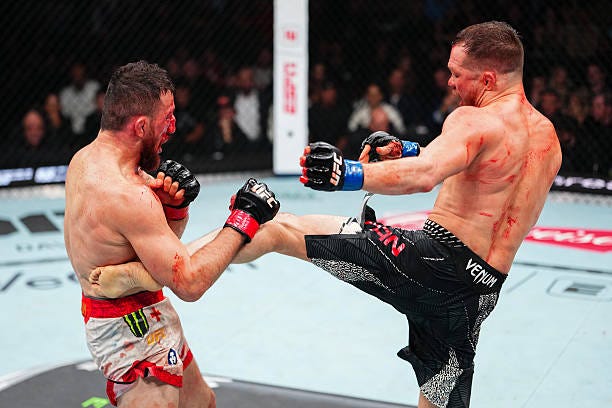
What probably no one expected was that Petr Yan would systemically tear apart Merab Dvalishvili into a retreating, bloody mess, winning every single round.
‘No Mercy’ and Occam’s Razor
Disclaimer: Before proceeding further, I would suggest familiarizing yourself with my breakdown of Petr Yan’s career and skillset, as I will be referencing a good number of regular practices of his here as well as how I believe he had approached his career prior to his performance here.
I’ve spoken about how someone would go about defeating Merab Dvalishvili, so let’s review what I said. First, understanding that Dvalishvili is not just a threat because of his incredible conditioning is a necessity. His feints and constant initiative must be addressed at any and all times. Ergo, to beat him, there are a number of things that must be done:
Dvalishvili’s excess of activity must be addressed, either positionally or with activity in some level of excess itself. In particular, his feints off his jab must be met with jabs as well consistently.
Dvalishvili works at all levels, so his opponents must do the same. The head, the midsection, and legs must be worked or threatened.
Dvalishvili can be made to hesitate via counters, intercepted via the clinch, and pressure. Therefore, he should be pushed to the fence as his retreating footwork is incredibly vulnerable.
Dvalishvili must be punished on the fence or when he retreats. This is why body work matters.
When you look at these in retrospect, there are a few fighters at Bantamweight’s current elite roster who can follow those steps, but it only makes sense, upon seeing the rematch play out, that the one best equipped to accomplish all of these pieces whilst still having the wherewithal and endurance to consider Dvalishvili’s rallies and wrestling would be Petr Yan himself.
Let’s get the surprisingly simple part out of the way first: Yan’s defensive wrestling has always been historically excellent, yet this fight was demonstrative of how systemically difficult he could be to take to the mat. Merab Dvalishvili has proven to be a gifted takedown artist in both open space and on the cage, but Yan opted to feed the single leg and demand that Dvalishvili drive him to the fence, opening up his back numerous times in the process. Against a dangerous back-taker like Aljamain Sterling, this would likely have consequences, but Dvalishvili was not his teammate and had different strengths, namely an engine that Sterling lacked. Still, despite being a gifted chain wrestler against the fence himself, Dvalishvili could get almost nothing done there.
I want to point to a few things Yan did to consistently combat Dvalishvili here:
Yan’s main defense was constantly attempting to wrench control of one of Dvalishvili’s arms to establish some form of wrist control or trying to get an under/overhook on the other arm, eventually turn inside off the fence, and separate.
When Dvalishvili often tried to drive off the single leg, Yan would often push or manipulate Dvalishvili’s head positioning to break said momentum, sometimes allowing him to frame and separate.
Yan would prop his foot into or around Dvalishvili’s to create space and a means to push his weight against Dvalishvili’s.
It needs to be said that this wouldn’t necessarily be possible without Yan’s physical attributes and incredible balance, but the ideas were spot on. The commonality with all of them was that they were to restrict Dvalishvili’s options into as little space of possible to create his trademark mat returns and transitions. But, the truth is, being able to address the wrestling was only part of the battle. The real task was to prevent Dvalishvili from getting to these positions to begin with.
From the very beginning, Yan enforced his pressure, looking to pin Dvalishvili in place, effectively putting the champion in a position where he’d have to reply with a series a feints, using his lead hand to pick out any and all offense at range. It didn’t take long for Dvalishvili to start jabbing, but it was immediately answered with a thudding, spearing jab by Yan.
I want to pause for a second and reemphasize one of Yan’s historical issues that, while he isn’t slow in establishing his positional control or his defense, he can be inconsistent insofar as using some tools that would make a key difference. This has led to an even greater problem of his need to solve opponents in tactile ways, often through the handfight. That said, through some of his last few fights, Yan was showing keen awareness to trust his shot selections, particularly his jab.
The principle reason Yan’s jab successfully gets the better of the lead hand battle with Dvalishvili lies in its versatility. Dvalishvili’s jab relies on its mixup with the hopsteps, often coming out as a throwaway off of one movement or for feeding his opponents the wrong reads. Yan’s counters this because he’s constantly and subtly utilizing it from different positions.
Yan would target the chest, actively dip as he jabbed to create a battering ram as an initial barrier for Dvalishvili to step past on his entries, pivot to the left to outposition Dvalishvili if they jabbed at once. But, most importantly, it was always in Dvalishvili’s face whenever they were circling or in neutral space, therefore ensuring that Yan was right in front of Dvalishvili himself constantly.
I doubt I need to explain Yan’s long guard again, but it’s worth mentioning that a good jabber can easily frame into a post that the long guard weaponizes and vice versa. If Yan wasn’t using his battering ram of a jab to stay close or reposition, his long guard would keep him safe and in control, even acting as a battering ram when Dvalishvili attempted to blitz forward. Yan’s long guard can be punished if you step in on it, but his constant jabbing constantly offset Dvalishvili’s comfort in doing so.
Should Dvalishvili have managed to get by the long guard, he ran into the high guard and Yan’s smothering with it. By stepping in with the high guard, Yan successfully could dip under and weave out of range, where the jabbing would renew where it left off.
And worst of all, Yan would employ his intercepting clinch game, ready on several fronts to prepare for Dvalishvili’s entries, whether they were blitzes, flurries or takedown attempts. The long guard made for easy enough collar ties, but the high guard allowed Yan to either sprawl or to dig his head into Dvalishvili’s chest (or head) and create space to grab wrists, under or overhooks, and actively turn Dvalishvili into the fence. You want to know why Yan had his rear hand below his chin so much? It was to prepare to grab Dvalishvili’s hands at any cost to stop the first layer of his takedowns.
And whenever he was able to, Yan made sure to punish Dvalishvili on the breaks or to create them. More astute observers will also note Yan is always turning Dvalishvili towards the fence and himself away from said cage wall. Regardless, as soon as that ended, the pressure continued and Yan was right back in his face again.
Remember how I once called Yan’s pressure uniquely different from others of that archetype? That it was more inclined to stay close to you to create constant, imminent danger? I’ve emphasized throughout that Yan is incredibly consistent about staying in Dvalishvili’s face. Why do you think that is? It seems counterintuitive on the surface, willing to lock horns up close with such a grappling threat that has a proven cardiovascular edge over everyone and is afraid to push every inch he’s given. After all, the takedown threat is a big one, a game-changer in Mixed Martial Arts standup. But what happens when someone isn’t afraid of that wrestling? What happens when someone makes a demand that you make them back up?
That’s the exact question that Yan answered, because by standing right in front of Dvalishvili, he made himself a threat to be taken seriously, and enforced it with the jab and endless proximity. Dvalishvili was still a chronic doer - game beyond normal reckoning - and that required particular measures to tame him.
Dvalishvili has made strides with his striking, but one of his clear weaknesses despite his incredible closing speed is that he still will come straight in on entry. This is why Yan had pointed counters, both kicks and punches, to shut that down. The terrifying aspect of Yan’s counterpunches were that they were also distance closers for him too - letting him have easy access to the clinch. This is why a good number of Yan’s choices on the counter had him level change. The counter kicks were, conversely, to create space or close off the exchange.
Another reason this worked like a charm wasn’t necessarily just the case of Yan hurting Dvalishvili, it was because he could turn Dvalishvili’s constant need for chaos by elongating the exchange against him, then outposition him and blast him with a counter. This is often why Yan would allow Dvalishvili to jab with him. With Yan’s transitional ability and efficient defense, he could account for even a ton of volume, answer back with the jab to reset until he was in a space to read the distance and counter when Dvalishvili committed to striking too much, successfully pressing once again.
To make ends meet after putting fear in Dvalishvili, Yan didn’t just wage a war of jabs to disrupt Dvalishvili’s lead hand, he went about handfighting it constantly. Consequently, it would force Dvalishvili to either step out of range or try to step in, making him infinitely more predictable as arguably his key weapon on the feet was being addressed. You’ve probably also noticed that Dvalishvili wasn’t able to get his kicking game off in this fight. It wasn’t just due to Yan standing close to him and parrying kicks with his long guard if they were far away, it was because Dvalishvili never knew what the safe range was to not be countered.
I refer to Dvalishvili as a ‘doer’ for a reason, as he’s very much built a game reliant around constantly building momentum for the sake of attrition. His style often involves seemingly artless activity, yet he has succeeded in making almost everyone across from him have to respect him. When Dvalishvili is comfortable, his mixups and setups flow seamlessly, causing his opponents to fall under his avalanche as he engages them in bout where every inch matters and he’s predisposed to try to always take more . So, what happens when Dvalishvili’s basic building blocks are taken away and he’s forced to take risks with dire repercussions?
If you were to narrow down the simplest of decisions that allowed Yan to rein Dvalishvili under his thrall, it all circles back to what I said: He demanded that Dvalishvili work for every inch he wanted and make him afraid to.
It was as though the same surgeon that had put Aljamain Sterling into a punishing self-imploding gameplan before that career-course-changing knee was back, now having turned his attention to a new patient, putting him through the same horrifying procedure, just from a different directionality. Sterling was punished into needing to continue his pace even though it would leave him an exhausted wreck; Dvalishvili was punished into never knowing how to even enforce his pace without penalty.
Nowhere is that more exemplified than when Dvalishvili was pinned to the fence, where Yan either kept him pinned for menacing setups with his kicks.
To keep Dvalishvili from ‘doing’, Yan kept him ‘thinking’ by weaponizing the clinch there to beat him down, even seeking takedowns of his own just to keep him worried.
The results spoke for themselves, as Yan corralled him in neutral space so effectively that Dvalishvili’s most expected route was likely to be a takedown - and whether he got to the tie-up or not, he already was met with answers.
By the fourth round, Yan was more comfortable than ever to open up on his offensive arsenal directly, where he, without wavering from any of his previous achievements, continued to dissect Dvalishvili into a bloodied, beaten husk.
And, if he wasn’t beating him down, Merab Dvalishvili was frought with constant concern, unsure how to initiate anything as Yan commanded every sector of the cage. Using these clips, consider each piece we described above and see how each continues to account for any and all momentum from building on Dvalishvili’s side whatsoever
Over the course of five rounds, Petr Yan went from the perceived greatest victim of the bantamweight kingpin’s conquest to the brutal, methodical usurper of his throne by christening it in the Georgian’s claret. He matched Dvalishvili’s intensity with fearlessness and ice-cold composure, and then defeated him in every phase possible that an MMA contest could have.
Conclusion: Qualities of Greatness
There’s a conversation I had a couple of months prior about what the absolute best in combat sports can do. That is, the best fighters have the ability to balance out of their strengths into multifaceted approaches for a variety of stylistic matchups; they are strategically prepped before the fight and constantly attentive during the fight to tactically adjust or account for what can happen. But there is one other, uniquely special characteristic: They have the notion to reflect, reinvent and reallocate their game to overcome adversity head-on without compromising their greatest attributes.
Petr Yan was known throughout his career as the man who figured out his opponents during his bouts better than anyone - who could solve any approach through his vast skillset. But fixations and reliances caught up with him as he ran into opponents who were willing to maximize their chances and leverage appropriate prefight measures - leading to him having closer fights than he maybe should have to being almost helpless in his definitive loss. There were margins of error that he wasn’t accounting for well enough. He could still act as a difficult ‘skill check’ that lesser opposition outside of the absolute best couldn’t overcome, but he himself fell short of his own incredible potential.
And that is precisely why what he accomplished in this rematch is so demonstrably impressive, because it’s obvious that he didn’t just reflect, he identified his own greatest weakness and made the means to address it. In this performance, you’ve probably noticed I didn’t speak about adjustments - Yan’s modus operandi - and that’s because he barely needed them. His preparation was superlative and weapons that pushed his advantages emerged from the very beginning - to seize the initiative from one of the greatest initiators and opportunists in elite MMA. Other fights in Yan’s career showed strategic thinking, but nothing on this scale. No, this was a maturation that could only have been made by the best fighters in the sport. Was it flawless and eliminated every issue Yan had? No, but it was perfect to handle a fellow generational talent whose style had never seemed like it was possible to lock down definitively without it being mutually grueling.
But even more astonishing is that, when you consider how the regular Mixed Martial Artist usually makes numerous changes to their in-fight methods, when you look at the things Yan did here, Yan never actually sacrificed the same economic, efficient approaches at all. He didn’t need to match Dvalishvili’s volume of activity, he just had to have the right activity that was still very in line with what he already did. He didn’t have to be content with being uncomfortable, he chose to stand in that fire devoid of anxiety that the Georgian fed upon and paid it back in full. Dvalishvili, the grinning lunatic whirlwind who could win even close rounds seemingly convincingly with moments and enthusiasm, found himself on the receiving end of the optics race, getting slammed on his dome and wearing the crimson mask. I don’t need to emphasize how extraordinary that is. Petr Yan remained the puzzle solver, the greatest adaptative technician in Mixed Martial Arts. Whether you want to point to how Yan is likely past his physical best, whether you want to emphasize Dvalishvili’s own engine in relation to his schedule, or whether you have some other miscellaneous caveat: Yan achieved an incredible rarity of solving the ‘nightmare matchup’ - and if that isn’t a narrative testament of greatness, then I don’t know what is.
There have been many impressive displays in Mixed Martial Arts this year, with Islam Makhachev’s grappling clinical on Jack Della Maddalena perhaps being many’s pick for the performance of the year due its sheer dominance. I don’t think it matches what Yan did, however, and let me explain why.
Over the last decade, led by Khabib Nurmagomedov’s crew, control grapplers and chain wrestlers have enacted a reign of terror over the Mixed Martial Arts scene that very few have combated, maximizing the fear of a takedown against prolific standup specialists in ways never seen before. This is why it’s often been unsurprising to see their dominance. But why Petr Yan’s performance truly stands out is that it asks the question, “Why be afraid at all?” If you’re matching their preparation effectively and then building organically during, then the takedown is just another aspect of Mixed Martial Arts instead of its seeming method of subjugation. No, why Petr Yan’s destruction of Merab Dvalishvili is truly special is that it incorporated every facet of Mixed Martial Arts - an exhibition of what the sport’s best can do.
This wasn’t the showing of a pressure fighter; it was someone who could do it all with pressure as a tool. In victory, Petr Yan embodied the ‘artist’ in ‘Mixed Martial Arts’, painting his masterpiece using the blood of the very demon from his greatest nightmare. It doesn’t matter what comes next for him, be it greater glory or another fall, this was a victory that stands as one of the greatest. It’s achievements like these are why Mixed Martial Arts enthralls its audiences to their core.
Thank you for reading.