
Standing Stubbornly Scorching In The Tumultuous Fire: Joshua Van
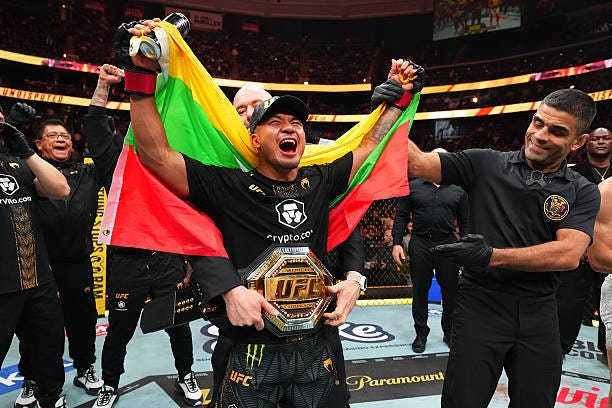
Newly-minted UFC Flyweight Champion Joshua Van has taken to becoming must-watch entertainment. This article explores his absurd striking talent in context of a extremely competitive weight class.

Introduction: A Brisk Look at 125lbs
After years of stability under the ironclad reign of the legendary Demetrious Johnson, the Flyweights found some resurgence of intrigue through the quadrilogy between Deiveson Figueiredo and Brandon Moreno - a series of twists, classics, controversies and broken visages. This obviously doesn’t tell the whole story of how the UFC had wanted to toss flyweight itself to the bin because of little interest despite having all the cards to promote a division whose king was a man who could suplex his opponents in midair into armbars or make them look less than ordinary - and that isn’t even to say the assortment of game stylists and scramblers that made up the rest of the rankings, even if the division’s number two, one Joseph Benavidez, played a foil to turnover as much as the champion did. Ultimately, Johnson himself did not want to pledge arbitrary allegiance to the whims of a company that wanted him to lose, so much of the actual excitement the division could generate was either understated or never given a spotlight. Admittedly, this doesn’t encapsulate the full picture of the behind-the-scenes politics, though I don’t think there’s any much room to argue that the UFC didn’t value the Flyweight division, nor did it really try - which tends to be par for the course. What I do think is that, even with the Figureiredo-Moreno rivalry aside, flyweight still remains criminally underappreciated.
It’s very healthy to view divisions as their own respective displays of Mixed Martial Arts’ talents employing a variety of skillsets in reaction to one another or in an attempt to control the directionality of the division itself. Flyweight is an interesting division in that, for all its dynamic displays of athleticism, I’ve struggled to pin down some of its developmental trends. Flyweight has always been a division that is a showcase for transitional scrambles with all-terrain ability, though it hasn’t necessarily evolved too far, merely maintaining it as a staple. This is to say, specialism doesn’t really reach the top of flyweight naturally due to the demand to be active in those areas so much. This is what makes everyone’s favorite crowned-under-bizarre-caveats Joshua Van so interesting to me. Van is far from incompetent across phases, but he sticks to his game’s premier strength, marching his man down and beating them up even worse. Van’s specialization in the context of flyweight’s usual philosophy shouldn’t be read as a mark against him nor the division; if anything, every division should have diversity for the sake of competition. Nor is this to say that specialists are an unknown commodity at flyweight, though I’d definitely argue boxing-stylists are especially rare in such a grappling focused division.
There’s little beating around the bush with how Van’s game operates in its offensive intentions. Van can crack hard enough to get the attention of any man across from him, though his value is built around punishment. Some can easily assume that attrition in combat sports involves debilitating attacks to the lower half alone, but Van’s offense exemplifies how it’s often more than that: his particularly ruthless body onslaught only adds to his battering of opponents upstairs until the culmination of punishment is too much. And sometimes, it really is as simple as everyone has a limit with how much they can endure - and Van’s striking is coordinated in dealing out agony.
The Jab as a Hammer, The Counter as an Anvil
The main facilitator of Van’s game is his active, versatile jab. Van’s isn’t admittedly anything unique compared to fellow high-volume lead hands in elite Mixed Martial Arts, though his is absolutely one of the most potent. Primarily, Van’s jab is most potent in how many variables it covers. Anyone familiar with this shot is already aware of the basics - distance measurement, a building block for combinations, etc.; therefore, I want to simplify on some specific kinds of uses Van has for it.
Van will alter the direction and placement of his jab even in volume, sometimes targeting upstairs, downstairs or even the chest after disguising his intention with an upper-body feint (usually the right hand). He’ll often do this to outposition opponents - especially those at distance or have a height advantage by stepping laterally at an angle.
Van will actively mess with retractions of his jab. This is, sometimes the throwaways themselves won’t fully commit or the actual touches will be ‘light’. When used with feints, Van can constantly catch his man unaware of a new setup, even from a deceptively close range.
Defensively, Van likes to extend the jab out and dip his forehead inside of the forearm as he frames out with it. Not only is this retractable, it will let him quickly reposition to fire a new jab.
All of these are nothing unusual if you’re familiar with what strong, persistent, and effective jabbers do in Mixed Martial Arts - though I would say Van’s applications are on the rarer side compared to the great majority. That said, the jab here is really about facilitating Van’s greatest strength as a stylist: an offensive counterpuncher.
There are many other features to note, such as Van’s constant use of the counter jab or closing off an exchange with one, but there’s nothing he loves more than using said jab to draw out opportunities to box faces off their foundations.
The premises of counterpunching typically involve patience and attentiveness to exchanges, though these principles are often seen as ways to discourage any kind of engagement. But this is notably a control tactic with obvious flexibility because they are dissuasion threats on top of being consequences. A counterpuncher can play the backfoot game for the sake of risk management and strike back when needed, but this doesn’t mean that playing the counterpunching game by standing your ground isn’t too much of a gamble in the hands of the right technician. In other words, an offensive counterpuncher enforces constant anxiety through consistent consequences. I’ve written about tenets of pressure fighting consistently, so this feature lends itself naturally to what someone on the frontfoot wants to do insofar as making opponents think twice before committing. And an aggressive fighter who pushes forward is going to incentivize their opponent to try and resist, thereby opening up new opportunities.
That said, I’m not entirely sure Van himself falls under my definition of a ‘pressure’ fighter despite the constant stress he puts on his man. And an enormous part of that lies in how Van snowballs his momentum through the counters themselves. I think it’ll become more clear why categorizing Van is a bit trickier than it seems as I explain. Ergo, my compromise is to categorize Van’s aggressiveness into two phases: the first is his defining trait, insistence on remaining on the frontfoot to enforce the possibility of pocket exchanges with steady, ‘inching’ forward-pressure. This will eventually build to the second, where offense becomes the only priority, in due time, though how we manifest that happening means being familiar with how Van gets there.
Pressure Mode
When inching forward, Van is actively watching his opponent while looking for ways to enter the pocket himself or baiting this opponent to enter his range for the counters. All the while, Van will use the range to keep stock of their actions while stalking them, picking off their offense and, most importantly, forcing them to constantly be on the move. Once the counters are established, Van is able to more keenly predict and handle mixups - the expectation is that they will do something once they plant, so the intention is to diffuse what they do in that moment and force them back on the move. Every ounce of space the opponent wants must be earned.
In particular, Van has a love for parrying or threatening to counter jabs coming back his direction.
Sometimes, he’ll even bait out the opponent’s jabs on purpose to specifically counteract them - again, making them think twice about an engagement. It’s especially useful against those with limited striking games who rely upon simple tools to get some momentum. Conventional wisdom is that jabbing still matters against even a better jabber, but Van’s tactics against them make especially orthodox-stance lead hands struggle to build momentum and exploit shallow striking habits.
That said, it’s not wrong to point to Van’s lead foot heavy movement makes him constantly susceptible to leg kicks, though I’d be remiss to point out that it’s proven easier said than done if he can predict them, often checking or pulling his leg back slightly. In the process, no ground is easily given nor lost.
This is all to say, even grapplers who need to use their strikes to create mixups can get their takedowns predicted and undone this way, often being framed away and then viciously punished for trying at all.
What remains are the tools Van uses to close the distance himself. You might have noticed Van’s consistent front kicks throughout this piece, though those are one of his main enforcers to preserve range or to corral opponents towards the fence. The actual points of interest are Van’s hopsteps while punching.
Van’s constantly pressing jab, touching his opponents into lesser space works wonders, though he will sometimes use a cross of the falling step but with a similar leap to a gazelle jab. Think of a falling step as a firm commitment to the lead foot’s weight while bouncing off the rear foot, but striking with the jab at the same time can make it somewhat like an untelegraphed spear striking at you. Where Van messes with this is that he often hops a little further than your average weight transfer and often upwards, trying to push his jab out as far as possible in case he needs to use the forearm for defense. This surprises his usually taller opponents in that he’s effectively rapidly changing levels whilst jabbing at an unexpected angle. Once in range, this tool is particularly devastating, as it allows Van to open up followup punches.
It should be noted though Van only uses these falling step pursuit tactics sparingly at a range where the opponent has planted without committing or if he needs to force a reset they don’t expect. This is why Van will feint at the hip before doing so, to prevent the possibility of being countered.
Van also will pursue his opponents with the lead right off the same principle falling motion, often blitzing in behind it - this is what you would call a darting cross. Otherwise, Van does love to use variations of the rear hand to step in, then quickly transitions to another jab to help ensure he isn’t punished as he regains his stance.
With all this said, we can finally return to the demonstrative strong suit of Van’s game, his wicked counterpunching. What makes Van such a prolific counterpuncher is that, not only does he fire in combination with alarming accuracy, his shot selection is tailor-made to work off of the last punch for a specific, respective purpose.
Van will pull after the jab draws out offense and rip uppercuts-into-left hooks, or a single thunderous right counter, possibly just a jab off a pivot. He may well just slip inside and rip to the midsection. He could well just not counter and catch for now.
Even in midst of his chaotic brawl with Brandon Royval, two consistent punches, especially in combination, would save him time and time again - and that would be his right hook, delivered in either a chopping or short arch, and the left hook, the go-to punch to shut exchanges down and quickly get space to breathe. What’s understated here is that punching upwards and across with the right allowed Van to disperse his weight quickly into the lead hook or cause Royval’s offense to bounce off his forearms. It’s no exaggeration to say this small interplay saved Van from taking far more damage than he did.
On the subject of the chopping right, I want to also say it may well be Van’s best punch besides his patented jab, which is why he often pairs them together. While a short right hook can slice the air between fighters at a horizontal angle in a way that closes an exchange but may not completely separate them, a chopping right is a downward, sharpened blow, often delivered at a diagonal angle across the body - the air is sliced more at a vertical angle depending upon the stature of the two fighters involved, but can often account for many guard types.
With this, Van uses it offensively and defensively. The exchange-closing ideas are still pertinent; however, you’ll see Van sometimes use the danger of the punch as an overhand to draw his opponent’s forehead into a different threat to shut down another point of danger, such as how he punishes Charles Johnson’s mixup to target Van’s lead side.
Swarmer Mode
In any case, it’s readily obvious how Van’s punching in combination shows him at his most lethal, and whereupon the second phase of his style manifests, search-and-destroy.
Once Van is able to step into range and assess that he isn’t going to be met with leads, he takes the initiative and gets to work, demonstrating some of the most diverse, devastating and creative striking arsenals in MMA history. Every trick is laid out in a flowchart of bludgeoning momentum, working off of and into the next piece of the beatdown. It’s here that opponents will either have to fight back or keep backing away.
Those that do the former are to discover that Van doubles down on countering; if anything, he is now trying to actively win every exchange - and his insistency increases exponentially.
What is perhaps Van’s scariest gift manifests here: he has uncanny accuracy in volume on even moving targets. This may seem not too abnormal unless you consider how few fighters across all striking combat sports can actually do that with minimalistic feints or setup; when those fighters let their hands go, they usually land with extraordinary precision. There is picturesque accuracy on single counters or targeted setups, but to throw in excess and land so much under the contexts the way Van has shown the ability to do so? I can maybe only think of a handful of other MMA-specific strikers who can do that. In other combat sports like boxing, you’d still have some trouble, arguably looking at unique stylists like Vicente Saldivar. It’s a trait I cannot explain what the ‘hows’ to; while it is possible that some of Van’s competition can flatter him a bit on this front, what we have seen is every bit a terrifying grasp of timing and rhythm.
In any case, the natural result is to often back off, and Van wishes to push his opponents to the fence for greater siege.
On the fence, Van wastes zero time looking to dish out a merciless beating. Whether it involves working the guards to employ among the most potent body attacks in the entire sport or bombing upstairs, it becomes apparent it is the worst place to be.
It’s with all of these pieces that Van has managed to storm his division as one of, if not the, talent to watch when his game works on all cylinders. There has yet to be an opponent who has gone into the cage with Van unscathed once leaving - and the tightrope to do so is getting shorter and shorter as he refines what he’s already excellent at, on top of a clear gift for being aware of what is or isn’t effective. Van is a young champion, already besting some elites of his division and likely will with many more to come - how he won the title presenting legitimacy on him being the world’s best aside - and to do so in a division like flyweight with enormous consistency is worth respect.
At the same time, it may surprise you to read that, as confident as you should be in Van’s talent, I also admit I can’t really pick him over any of his fellow elites with the same confidence - and vice versa. The best way to explain is that I have to emphasize Van’s primary issue.
Playing with Fire
Remember how I said Van isn’t necessarily someone who fights exactly like a pressure fighter despite having the obvious gifts and strengths of one perfectly suited to? In many ways, this is because Van’s own pressure relies upon his own insistence to use the pocket more than his footwork. In other words, while Van brings the looming threat of being in a firefight, there are numerous times where I don’t think he has to so readily engage to make his opponents hesitate - and sometimes, doing so has led to him getting hurt or worse.
Think of it this way: Van does employ certain feints at some distance, but he can be inconsistent, instead narrowing down on patiently waiting for his opponent’s positional change or shot selection to find the right strike to employ. Because he gains a growing desire to commit and land, there are numerous times where he might let the opponent off the fence and has to pursue them all over again.
He can afford this with his grasp of distance and precision punching, and while I do think he has improved in some ways as his current winning steak at incorporating disorienting fakes into his style, in others, I see the extreme violence Van can unleash and how well he can control his opponents and have to ask if he’s almost too fixated on engaging every exchange possible as his route to build momentum.
And this has had Van getting into trouble that he could stand to navigate, ranging from being intercepted into tie-ups or even just getting blasted with counters.
This is a core weakness of specialization with fighter archetypes; you can cater your game around a singular strength, but it must be able to handle a wide variety of stylistic opponents and diverse amounts of situations. I emphasize one of Mixed Martial Arts’ greatest appeals is its diversity of styles allows for chaotic fluidity across divisions - and that the ones who emerge as the best are those who enforce their games the best or can have answers in all areas just enough, yet you aren’t going to cover every single area.
Joshua Van’s home turf is the pocket, which means he has to push his opponents into it or enforce the threat of it. This means those who can traverse ranges or apply mixups to keep him at bay are going to have success buying time no matter how insistent he is at pressing them.
One of the byproducts of that is that filling the space between them with volume and noise can lead to Van’s defensive preoccupations becoming overloaded, especially if he can’t press or account for everything coming his way. Van is extremely attentive at distance at picking off shots, but, if he commits too much to playing the observer, it can get him in trouble as his opponents start building comfort - it means more things he has to figure out how to stop when he gets going.
And this is especially relevant insofar as bringing up Van’s imperfect pressure footwork again. While he can cut the cage off, the counterpunching-centric tools to force retreats means Van has to have the opponent and himself on the centerline constantly. Opponents who take time to reset it even while throwing force Van to follow them instead of restricting their space.
In his knockout loss to Charles Johnson, Van’s exchange reliance was capitalized upon as Johnson actively engaged, then disengaged from Van whilst keeping him guessing with volume and redirections time-and-time again.
Between rounds, Johnson’s coaches understood the need to punish Van’s stubborn methods whilst navigating the zones of danger - their advice ended up being spot on as far as how Johnson set Van up for a fall.
This wasn’t to say that Johnson’s team weren’t proven correct in their assessment of how dangerous Van was, what with Van actively refusing to give easy ground and getting Johnson to the fence again and again.
Another point is how Van is a bit untested against active clinch threats, especially with those who like to turn him; however, I wouldn’t say clinches against Van are free, as he’ll pull the Sugar Ray Robinson tactic of punching his way out of there.
What happens if this isn’t enough though, especially against the kind of fighter who can get to where he can’t punch - such as his backside?
On the other side of the spectrum, I don’t think there’s a better indication of Van’s own stubbornness making things harder for him than they needed to be than in the Royval war.
In fairness to Van, Royval relied upon his durability as a serious crutch to deal with the damage, resulting in a superbly violent fight where his unorthodox volume led to longer exchanges that Van’s counters had only partial success in backing his taller adversary off.
Again, the issue lands with Van’s insistency here. While Royval disguised a ton of entries to compensate for his vulnerability to the counterpunches, his sheer doggedness effectively forced Van into an arms’ race of escalating damage and potential panic where Van’s sharper mechanics and last minute adjustments barely won out.
I should emphasize that said adjustment by Van is a testament to him, his composure under fire, and how even if his stubbornness is punishable, he can eventually make the right decisions. The problem therein lies in ‘eventually’. While there’s some question of another being able to draw Van into the kind of feral barnburner that Royval did is unknown, I do have to wonder if a fellow pocket enthusiast with more pop in their shots can get Van’s attention earlier.
Conclusion: Inevitable Sensation
I feel that’s the thing with Van ultimately; I can point to many of his weaknesses, yet there is a seeming answer or caveat to a good deal of them that leads to a lot of unknowns. There are times I wonder if he’s been flattered depending upon who he faces, though, in the current status of an exciting flyweight division, where we have a wide spectrum of fresh matchups for Van to go against, ranging from crafty veterans to dynamic prospects, I can only say I can’t wait to see what happens next. The Pantoja fight is practically an inevitable test of Van’s micromanagements against one of the division’s most dogged, cunning cage generals. Manel Kape and the improving Lone’er Kavanagh have the striking acumen to punish some of Van’s recklessness. The return of Kyoji Horiguchi is also an opponent who has the arsenal, guile, and experience to test Van’s talent. I have my skepticism and worries about Van, especially insofar as how action-packed his run has been for his longevity, but the reverse is also true in that there is no way I can count him out no matter what.
Flyweight is settling into its’ next generation, where a fighter like Joshua Van is the one currently spearheading that charge. That’s all the reason you need to tune into what almost guarantees scintillating action. Be thankful for him as long as he’s got the fuel in his veins.
Thank you for reading.